Case Study: Replicating Mishra et al. (2020)
Sebastian Funk
2026-08-25
Source:vignettes/mishra-case-study.Rmd
mishra-case-study.RmdIntroduction
This vignette demonstrates how to replicate the analysis from Mishra et al. (2020) of COVID-19 transmission dynamics in South Korea using EpiAwareR. This case study showcases the compositional modelling approach by building a complete epidemiological model from three reusable components.
The analysis estimates the time-varying reproduction number () using:
- AR(2) latent process for smooth evolution of log
- Renewal equation for infection dynamics
- Negative binomial observation model for overdispersed case counts
Data Preparation
We use the actual South Korea COVID-19 data from the preprint, which
is included in the package. The data comes from the
covidregionaldata R package and contains daily confirmed
cases from January to July 2020.
# Load South Korea COVID-19 data
data_path <- system.file("extdata", "south_korea_data.csv", package = "EpiAwareR")
south_korea <- read.csv(data_path)
south_korea$date <- as.Date(south_korea$date)

# Prepare full dataset - tspan will select the window
# Column must be named 'y_t' for EpiAware
full_data <- data.frame(
  date = south_korea$date,
  y_t = south_korea$cases_new
)

# Preview the training window (days 45-80)
# This corresponds to Feb 13 - Mar 19, 2020 (the main epidemic wave)
cat("Training window (tspan 45-80):\n")
#> Training window (tspan 45-80):
print(full_data[45:80, ])
#>          date y_t
#> 45 2020-02-13   0
#> 46 2020-02-14   0
#> 47 2020-02-15   0
#> 48 2020-02-16   1
#> 49 2020-02-17   1
#> 50 2020-02-18   1
#> 51 2020-02-19  15
#> 52 2020-02-20  34
#> 53 2020-02-21  75
#> 54 2020-02-22 190
#> 55 2020-02-23 256
#> 56 2020-02-24 161
#> 57 2020-02-25 130
#> 58 2020-02-26 254
#> 59 2020-02-27 449
#> 60 2020-02-28 427
#> 61 2020-02-29 909
#> 62 2020-03-01 595
#> 63 2020-03-02 686
#> 64 2020-03-03 600
#> 65 2020-03-04 516
#> 66 2020-03-05 438
#> 67 2020-03-06 518
#> 68 2020-03-07 483
#> 69 2020-03-08 367
#> 70 2020-03-09 248
#> 71 2020-03-10 131
#> 72 2020-03-11 242
#> 73 2020-03-12 114
#> 74 2020-03-13 110
#> 75 2020-03-14 107
#> 76 2020-03-15  76
#> 77 2020-03-16  74
#> 78 2020-03-17  84
#> 79 2020-03-18  93
#> 80 2020-03-19 152

# Plot the training data
plot(full_data$date[45:80], full_data$y_t[45:80], type = "b",
     xlab = "Date", ylab = "Daily Cases",
     main = "South Korea COVID-19 Cases (Feb 13 - Mar 19, 2020)")
Model Components
1. Latent Process: AR(2) Model
The AR(2) process models the evolution of log over time with temporal autocorrelation:
where .
ar2 <- AR(
  order = 2,
  damp_priors = list(
    truncnorm(0.1, 0.05, 0, 1), # ρ₁: Second-order coefficient
    truncnorm(0.8, 0.05, 0, 1)  # ρ₂: First-order (strong autocorrelation)
  ),
  init_priors = list(
    norm(-1.0, 0.1), # Initial value for lag 1
    norm(-1.0, 0.5)  # Initial value for lag 2
  ),
  std_prior = halfnorm(0.5) # σ: Innovation standard deviation
)
#> Starting Julia ...

print(ar2)
#> <EpiAware AR(2) Latent Model>
#>   Damping priors: 2
#>   Init priors: 2
#>   Innovation std prior: specified
Prior choices (from Mishra et al. 2020):
- First-order damping coefficient ρ₂ centered at 0.8 reflects strong autocorrelation in log Rt
- Second-order damping coefficient ρ₁ centered at 0.1 for smooth dynamics
- Initial values centered at -1 on log scale (Rt ≈ 0.37 initially)
- Innovation std of 0.5 allows flexibility in Rt changes
2. Infection Model: Renewal Equation
The renewal equation models new infections based on past infections and generation time:
where is the discretized generation time distribution.
renewal <- Renewal(
  gen_distribution = gamma_dist(6.5, 0.62), # Shape and scale parameters
  initialisation_prior = norm(log(1.0), 1.0) # Prior on initial log infections (wide)
)

print(renewal)
#> <EpiAware Renewal Infection Model>
#>   Generation distribution: Gamma
#>   Initialisation prior: specified
Key parameters:
- Generation time: Mean ~6.5 days (typical for COVID-19 in early 2020)
- Gamma distribution allows flexible shape
- Initial infections seeded near 1 with wide prior (sd=1.0 on log scale)
3. Observation Model: Negative Binomial
Links latent infections to observed case counts with overdispersion:
where controls overdispersion (clustering).
# The preprint fixes cluster_factor to 0.25
# We approximate this with a tight truncated normal prior
negbin <- NegativeBinomialError(
  cluster_factor_prior = truncnorm(0.25, 0.01, 0, 1)
)

print(negbin)
#> <EpiAware Negative Binomial Observation Model>
#>   Cluster factor prior: truncated(Normal(mean, sd), lower, upper)
Parameterization:
- Cluster factor = (coefficient of variation)
- Fixed to 0.25 (via tight prior) as in the preprint
- More interpretable than directly specifying
Compose and Fit
Create Complete Model
model <- EpiProblem(
  epi_model = renewal,
  latent_model = ar2,
  observation_model = negbin,
  tspan = c(45, 80) # Exact tspan from preprint (Feb 13 - Mar 19, 2020)
)

print(model)
#> <EpiAware Epidemiological Model>
#>   Time span: 45 to 80
#>   Components:
#>     - Infection model: epiaware_renewal
#>     - Latent model: epiaware_ar
#>     - Observation model: epiaware_negbin
The EpiProblem combines components into a joint Bayesian
model with automatic validation. The tspan = c(45, 80)
selects days 45-80 from the full dataset, matching the preprint
exactly.
Bayesian Inference
We use NUTS (No-U-Turn Sampler) with Pathfinder initialization for posterior inference:
results <- fit(
  model = model,
  data = full_data, # Pass full dataset; tspan selects the window
  method = nuts_sampler(
    warmup = 1000, # Adaptation iterations
    draws = 2000, # Posterior samples per chain (matches preprint)
    chains = 4 # Independent chains for convergence assessment
  )
)
#> Generating Turing.jl model...
#> Running NUTS sampling...
#>   Chains: 4
#>   Warmup: 1000
#>   Draws: 2000
#>   Running Pathfinder initialization...
#>   Pathfinder init failed, using default initialization...
#> Processing results...Note: Fitting typically takes 2-5 minutes on modern hardware.
Results
Convergence Diagnostics
print(results)
#> <EpiAware Model Fit>
#>
#> Model:
#>   Time span: 45 to 80
#>   Infection model: epiaware_renewal
#>   Latent model: epiaware_ar
#>   Observation model: epiaware_negbin
#>
#> Sampling:
#>   Method: NUTS
#>   Chains: 4
#>   Draws: 2000 (per chain)
#>
#> Convergence:
#>   Max Rhat: 1.009
#>   Min ESS (bulk): 2059
#>
#> Use summary() for parameter estimates
#> Use plot() to visualize results
Check for:
- Rhat < 1.1: Chains have converged to the same distribution
- ESS > 100: Sufficient effective sample size for inference
- No divergent transitions: NUTS is exploring the posterior efficiently
Parameter Summaries
# Detailed posterior summaries
summary(results)
#> # A tibble: 53 × 10
#>    variable    mean  median     sd    mad      q5    q95  rhat ess_bulk ess_tail
#>    <chr>      <dbl>   <dbl>  <dbl>  <dbl>   <dbl>  <dbl> <dbl>    <dbl>    <dbl>
#>  1 latent.… -0.992  -0.992  0.0993 0.0972 -1.15   -0.830 1.00    10064.    6079.
#>  2 latent.… -0.656  -0.655  0.479  0.486  -1.45    0.119 1.000    7310.    5555.
#>  3 latent.…  0.0845  0.0833 0.0401 0.0417  0.0200  0.153 1.00     3948.    2319.
#>  4 latent.…  0.808   0.809  0.0436 0.0445  0.735   0.880 1.000    4807.    3499.
#>  5 latent.…  0.555   0.547  0.0907 0.0880  0.421   0.720 1.00     3083.    4897.
#>  6 latent.…  0.955   0.949  0.900  0.894  -0.534   2.45  1.00     8133.    5416.
#>  7 latent.…  1.38    1.40   0.895  0.880  -0.111   2.82  1.000    8798.    5836.
#>  8 latent.…  1.24    1.24   0.903  0.913  -0.247   2.73  1.00    10468.    6396.
#>  9 latent.…  1.18    1.19   0.882  0.906  -0.264   2.63  1.00     9385.    5417.
#> 10 latent.…  2.16    2.15   0.816  0.805   0.838   3.52  1.00     8982.    5662.
#> # ℹ 43 more rows
Key parameters to examine:
- AR damping coefficients (, ): Autocorrelation strength
- Innovation std (): Variability in changes
- Cluster factor: Degree of case count overdispersion
- Initial infections: Epidemic seeding
Working with posterior draws
epiaware_fit objects integrate directly with the posterior package. You can
convert the samples to any draws format for use with bayesplot, loo, or
other packages:
library(posterior)
#> This is posterior version 1.7.0
#>
#> Attaching package: 'posterior'
#> The following objects are masked from 'package:stats':
#>
#>     mad, sd, var
#> The following objects are masked from 'package:base':
#>
#>     %in%, match

# Convert to draws_df for tidy workflows
draws <- as_draws_df(results)
head(draws)
#> # A draws_df: 6 iterations, 1 chains, and 53 variables
#>   latent.ar_init.1. latent.ar_init.2. latent.damp_AR.1. latent.damp_AR.2.
#> 1             -0.96             -0.57             0.043              0.80
#> 2             -0.97             -0.72             0.090              0.84
#> 3             -1.03             -0.53             0.047              0.77
#> 4             -0.98             -0.16             0.080              0.83
#> 5             -0.86             -0.11             0.126              0.77
#> 6             -1.11              0.38             0.092              0.78
#>   latent.std latent.ϵ_t.1. latent.ϵ_t.2. latent.ϵ_t.3.
#> 1       0.46         -0.10          1.00          1.54
#> 2       0.38          2.49          1.11          0.48
#> 3       0.67         -0.62          1.54          2.06
#> 4       0.33          2.80          1.90          0.32
#> 5       0.57          0.42          0.93          1.31
#> 6       0.47          0.60          1.73          1.12
#> # ... with 45 more variables
#> # ... hidden reserved variables {'.chain', '.iteration', '.draw'}

# Find AR damping and std parameters by pattern
all_vars <- variables(draws)
ar_vars <- grep("damp_AR|latent\\.std", all_vars, value = TRUE)
ar_vars
#> [1] "latent.damp_AR.1." "latent.damp_AR.2." "latent.std"

# Summarise the AR-related parameters
subset_draws(draws, variable = ar_vars) |>
  summarise_draws()
#> # A tibble: 3 × 10
#>   variable        mean median     sd    mad     q5   q95  rhat ess_bulk ess_tail
#>   <chr>          <dbl>  <dbl>  <dbl>  <dbl>  <dbl> <dbl> <dbl>    <dbl>    <dbl>
#> 1 latent.damp_… 0.0845 0.0833 0.0401 0.0417 0.0200 0.153 1.00     3948.    2319.
#> 2 latent.damp_… 0.808  0.809  0.0436 0.0445 0.735  0.880 1.000    4807.    3499.
#> 3 latent.std    0.555  0.547  0.0907 0.0880 0.421  0.720 1.00     3083.    4897.
This also enables bayesplot diagnostics:
library(bayesplot)

# Trace plots for AR damping coefficients
damp_vars <- grep("damp_AR", variables(as_draws_array(results)), value = TRUE)
mcmc_trace(as_draws_array(results), pars = damp_vars)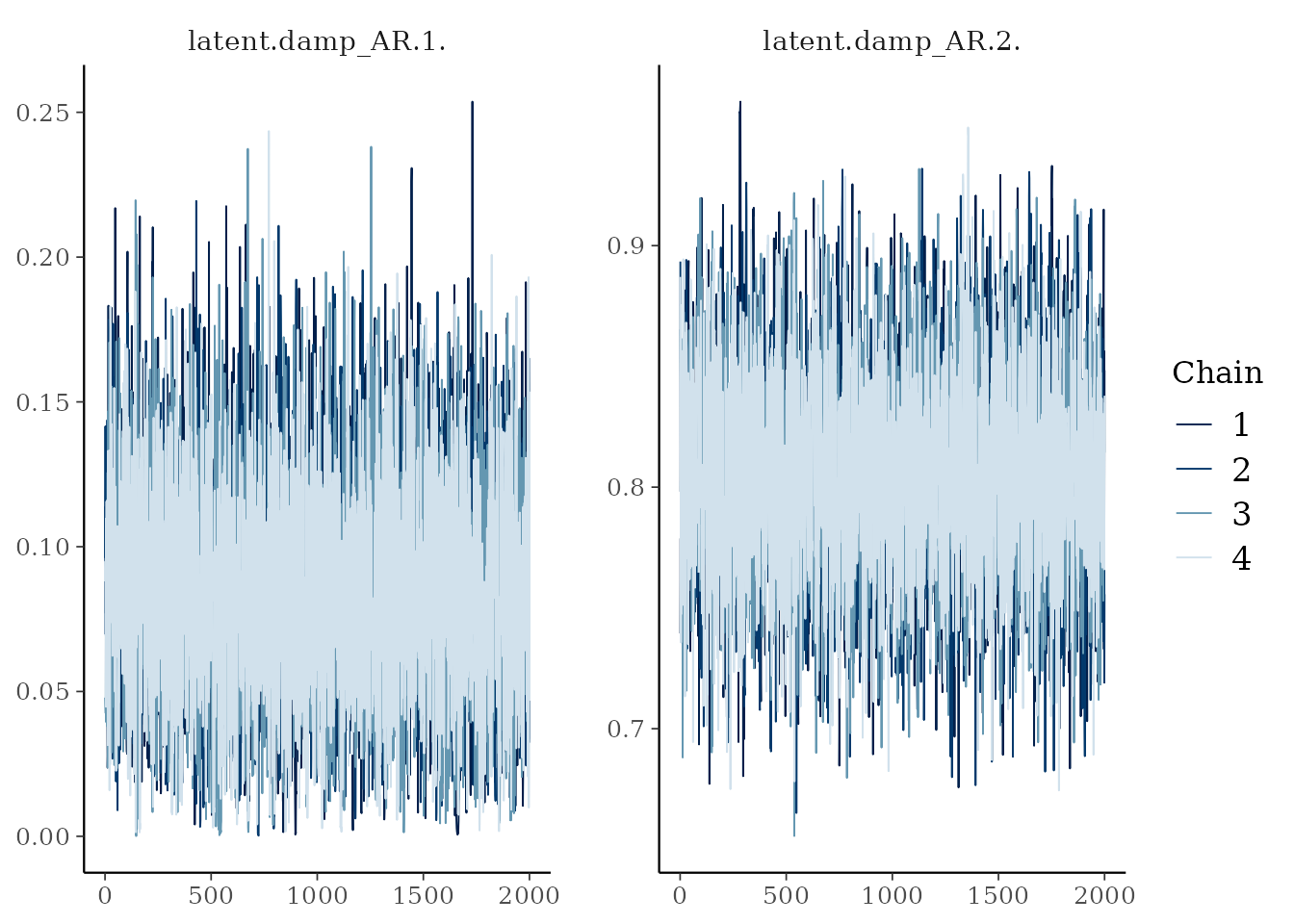
Visualization
# Time-varying reproduction number with credible intervals
plot(results, type = "Rt")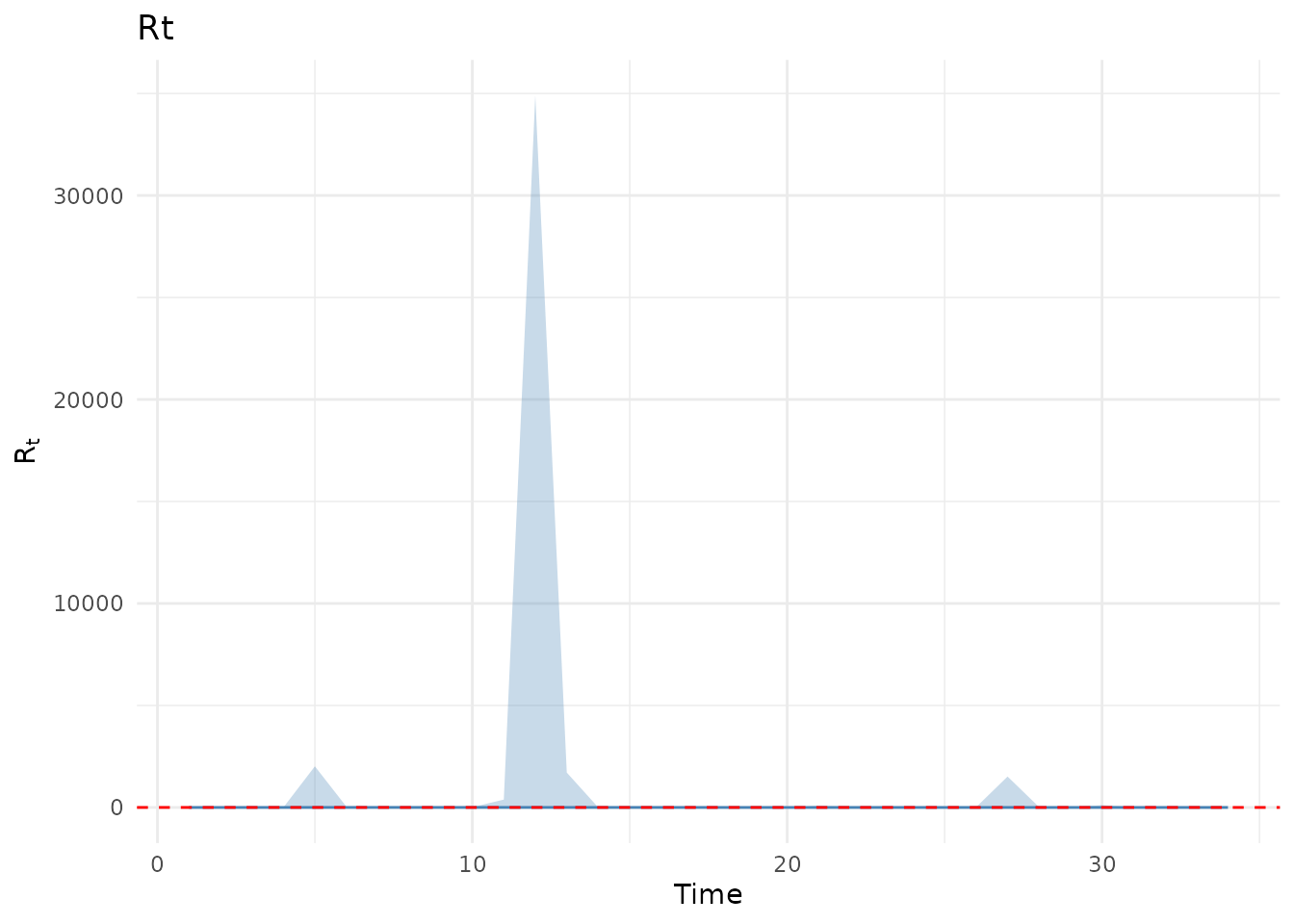
# Observed vs predicted case counts
plot(results, type = "cases")
#> Could not simulate cases from model parameters.
#> Available parameters: latent.ar_init.1., latent.ar_init.2., latent.damp_AR.1., latent.damp_AR.2., latent.std, latent.ϵ_t.1., latent.ϵ_t.2., latent.ϵ_t.3., latent.ϵ_t.4., latent.ϵ_t.5., latent.ϵ_t.6., latent.ϵ_t.7., latent.ϵ_t.8., latent.ϵ_t.9., latent.ϵ_t.10., ...
# Posterior distributions for key parameters
plot(results, type = "posterior")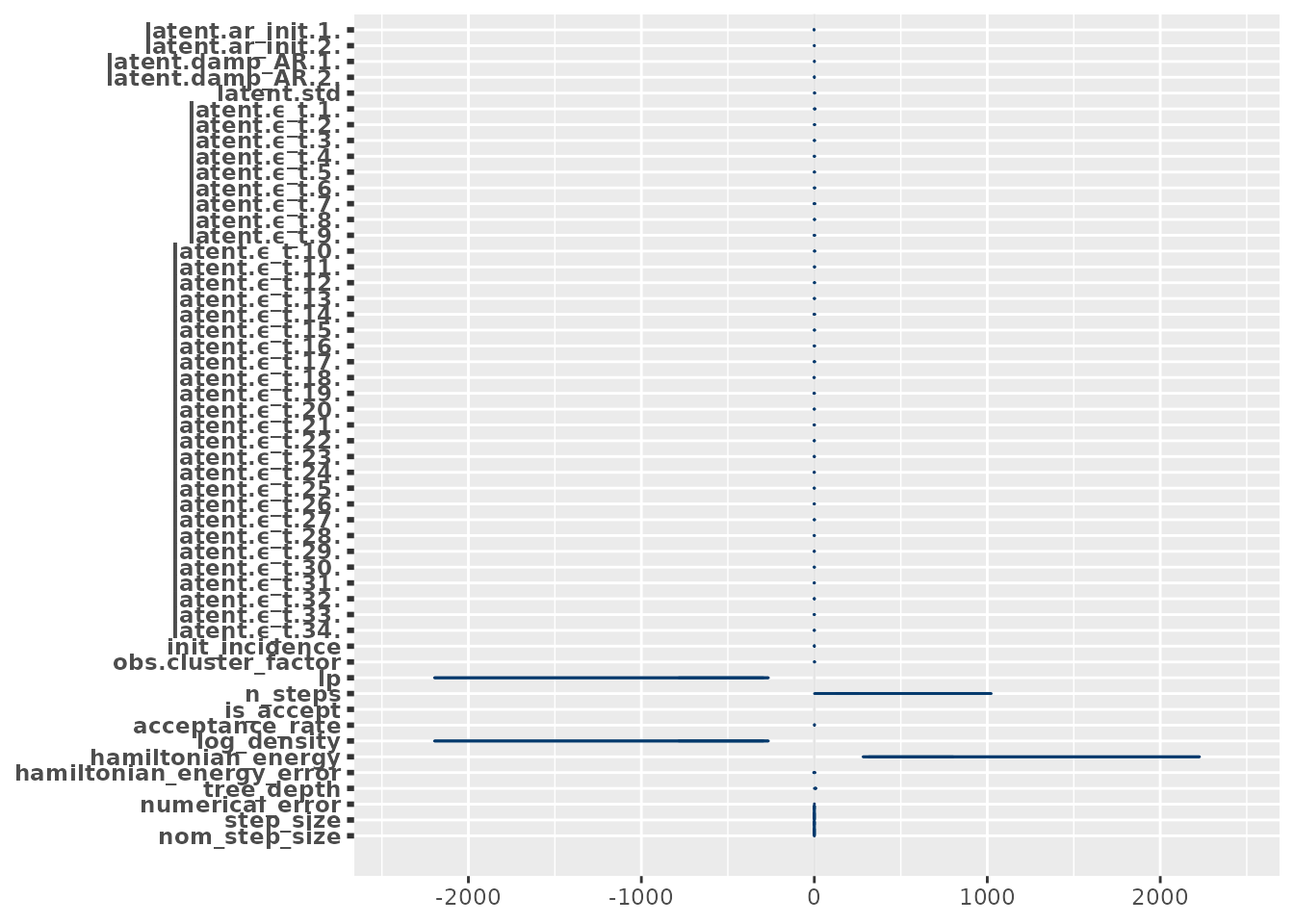
Model Comparisons
Comparing Latent Processes
Test sensitivity to AR order:
# AR(1) alternative - strong autocorrelation like AR(2)
ar1 <- AR(
  order = 1,
  damp_priors = list(truncnorm(0.8, 0.05, 0, 1)),  # High autocorrelation
  init_priors = list(norm(-1.0, 0.5)),
  std_prior = halfnorm(0.5)
)

model_ar1 <- EpiProblem(
  epi_model = renewal,
  latent_model = ar1,
  observation_model = negbin,
  tspan = c(45, 80)
)

results_ar1 <- fit(model_ar1, data = full_data)
#> Generating Turing.jl model...
#> Running NUTS sampling...
#>   Chains: 4
#>   Warmup: 1000
#>   Draws: 1000
#>   Running Pathfinder initialization...
#>   Pathfinder init failed, using default initialization...
#> Processing results...
Compare the estimates from both models:
library(ggplot2)
library(patchwork)

p_ar2 <- plot(results, type = "Rt") +
  ggtitle("AR(2) Model") +
  coord_cartesian(ylim = c(0, 6))

p_ar1 <- plot(results_ar1, type = "Rt") +
  ggtitle("AR(1) Model") +
  coord_cartesian(ylim = c(0, 6))

p_ar2 + p_ar1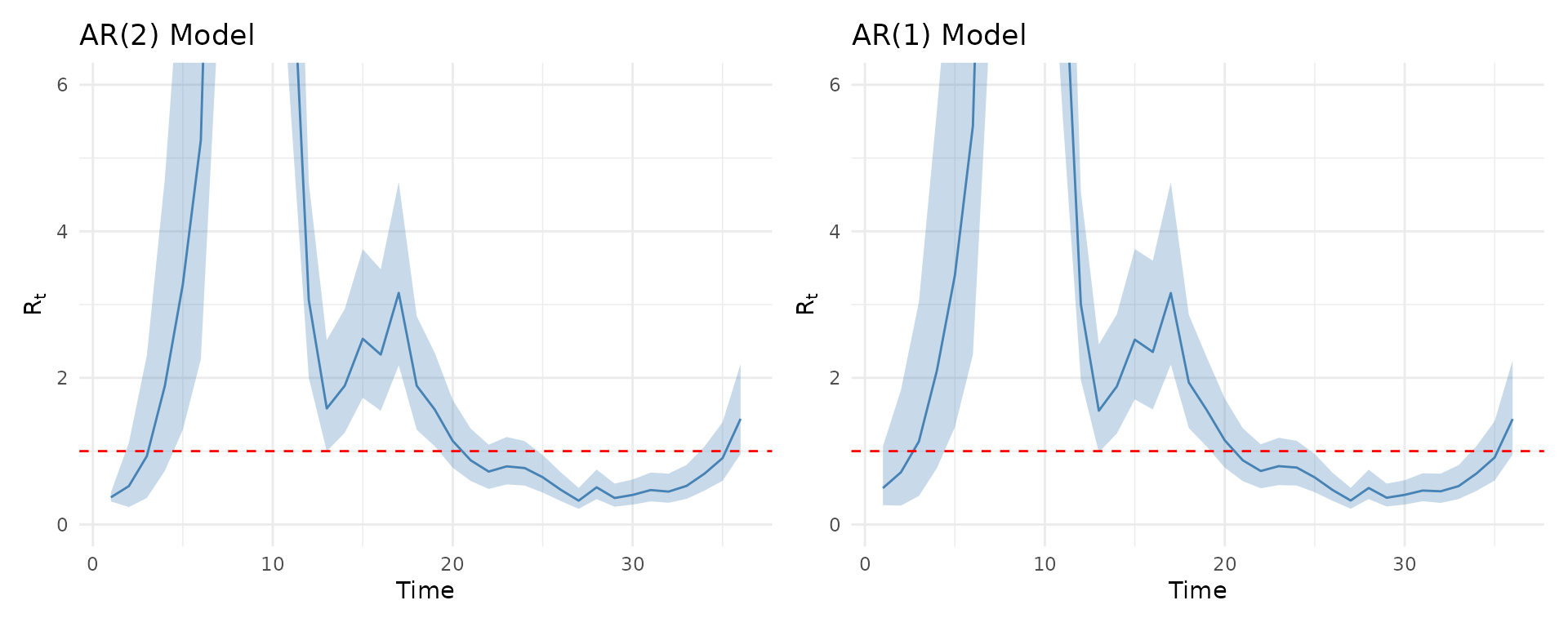
The AR(2) model typically produces smoother trajectories due to the additional lag term, while AR(1) may show more rapid fluctuations.
Adding Observation Delays
Account for incubation and reporting delays:
# Incubation period (~5 days)
obs_incubation <- LatentDelay(
  model = negbin,
  delay_distribution = lognorm(1.6, 0.42)
)

# Reporting delay (~2 days)
obs_full <- LatentDelay(
  model = obs_incubation,
  delay_distribution = lognorm(0.58, 0.47)
)

model_delays <- EpiProblem(
  epi_model = renewal,
  latent_model = ar2,
  observation_model = obs_full,
  tspan = c(45, 80)
)

results_delays <- fit(model_delays, data = full_data)
#> Generating Turing.jl model...
#> Running NUTS sampling...
#>   Chains: 4
#>   Warmup: 1000
#>   Draws: 1000
#>   Running Pathfinder initialization...
#>   Pathfinder init failed, using default initialization...
#> Processing results...
Compare models with and without observation delays:
p_no_delay <- plot(results, type = "Rt") +
  ggtitle("Without Delays") +
  coord_cartesian(ylim = c(0, 6))

p_delay <- plot(results_delays, type = "Rt") +
  ggtitle("With Incubation + Reporting Delays") +
  coord_cartesian(ylim = c(0, 6))

p_no_delay + p_delay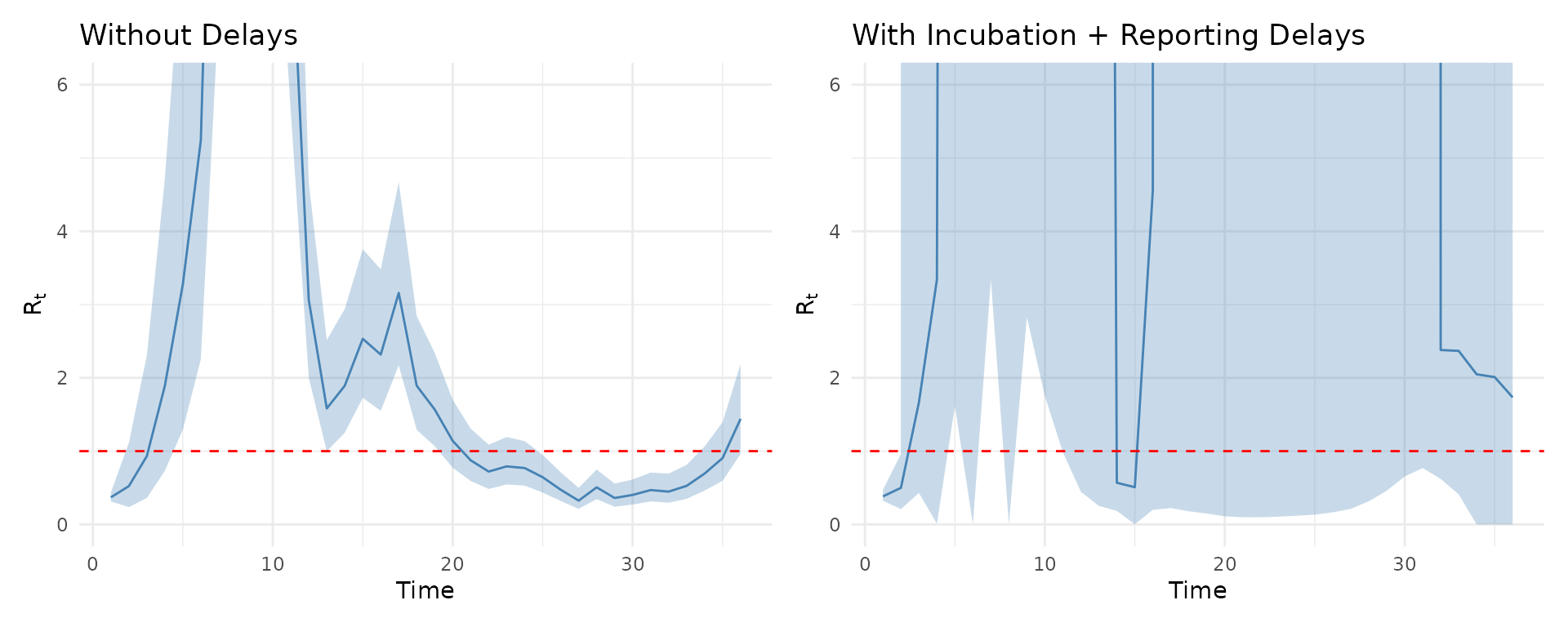
Accounting for delays shifts the trajectory earlier in time, as infections precede observed cases.
Interpretation
The Mishra et al. (2020) analysis demonstrated:
- Flexible estimation: AR(2) captures both smooth trends and rapid changes
- Uncertainty quantification: Bayesian credible intervals reflect parameter uncertainty
- Intervention detection: Sharp decline in coincides with public health measures
- Compositional flexibility: Easy to test alternative assumptions (AR order, delays)
Extensions
Try modifying the analysis:
- Different priors: Test sensitivity to prior choices
- Alternative latent models: MA, random walk, spline models
- Stratification: Separate models by age group or region
- Forecast evaluation: Hold-out validation of predictive performance
References
Mishra, S., Berah, T., Mellan, T. A., et al. (2020). On the derivation of the renewal equation from an age-dependent branching process: an epidemic modelling perspective. arXiv preprint arXiv:2006.16487.
Session Info
sessionInfo()
#> R version 4.6.1 (2026-06-24)
#> Platform: x86_64-pc-linux-gnu
#> Running under: Ubuntu 24.04.4 LTS
#>
#> Matrix products: default
#> BLAS:   /usr/lib/x86_64-linux-gnu/openblas-pthread/libblas.so.3
#> LAPACK: /usr/lib/x86_64-linux-gnu/openblas-pthread/libopenblasp-r0.3.26.so;  LAPACK version 3.12.0
#>
#> locale:
#>  [1] LC_CTYPE=C.UTF-8       LC_NUMERIC=C           LC_TIME=C.UTF-8
#>  [4] LC_COLLATE=C.UTF-8     LC_MONETARY=C.UTF-8    LC_MESSAGES=C.UTF-8
#>  [7] LC_PAPER=C.UTF-8       LC_NAME=C              LC_ADDRESS=C
#> [10] LC_TELEPHONE=C         LC_MEASUREMENT=C.UTF-8 LC_IDENTIFICATION=C
#>
#> time zone: UTC
#> tzcode source: system (glibc)
#>
#> attached base packages:
#> [1] stats     graphics  grDevices utils     datasets  methods   base
#>
#> other attached packages:
#> [1] patchwork_1.3.2      ggplot2_4.0.3        bayesplot_1.15.0
#> [4] posterior_1.7.0      EpiAwareR_0.2.0.9000
#>
#> loaded via a namespace (and not attached):
#>  [1] tensorA_0.36.2.1     sass_0.4.10          utf8_1.2.6
#>  [4] generics_0.1.4       stringi_1.8.9        digest_0.6.39
#>  [7] magrittr_2.0.5       evaluate_1.0.5       grid_4.6.1
#> [10] RColorBrewer_1.1-3   fastmap_1.2.0        plyr_1.8.9
#> [13] jsonlite_2.0.0       backports_1.5.1      scales_1.4.0
#> [16] textshaping_1.0.5    jquerylib_0.1.4      abind_1.4-8
#> [19] cli_3.6.6            rlang_1.3.0          withr_3.0.3
#> [22] cachem_1.1.0         yaml_2.3.12          otel_0.2.0
#> [25] tools_4.6.1          reshape2_1.4.5       checkmate_2.3.4
#> [28] JuliaConnectoR_1.1.5 dplyr_1.2.1          vctrs_0.7.3
#> [31] R6_2.6.1             ggridges_0.5.7       matrixStats_1.5.0
#> [34] lifecycle_1.0.5      stringr_1.6.0        fs_2.1.0
#> [37] ragg_1.5.2           pkgconfig_2.0.3      desc_1.4.3
#> [40] pkgdown_2.2.1        pillar_1.11.1        bslib_0.12.0
#> [43] gtable_0.3.6         Rcpp_1.1.2           glue_1.8.1
#> [46] systemfonts_1.3.2    xfun_0.60            tibble_3.3.1
#> [49] juliaready_0.1.0     tidyselect_1.2.1     knitr_1.51
#> [52] farver_2.1.2         htmltools_0.5.9      labeling_0.4.3
#> [55] rmarkdown_2.31       compiler_4.6.1       S7_0.2.2
#> [58] distributional_0.8.1