Getting Started with EpiAwareR
Sebastian Funk
2026-08-25
Source:vignettes/EpiAwareR.Rmd
EpiAwareR.RmdWhat is EpiAwareR?
EpiAwareR is an R interface to the Julia-based EpiAware compositional infectious disease modelling framework. It enables you to build flexible epidemiological models by composing reusable components rather than writing monolithic models from scratch.
The Compositional Approach
Instead of implementing complete models, you combine three types of components:
┌─────────────────┐
│ Latent Model    │  How Rt evolves over time
│ (e.g., AR, MA)  │  (random walk, autoregressive, etc.)
└────────┬────────┘
         │
         ↓
┌─────────────────┐
│ Infection Model │  How infections are generated
│ (e.g., Renewal) │  (renewal equation, SIR, etc.)
└────────┬────────┘
         │
         ↓
┌─────────────────┐
│ Observation     │  How infections become data
│ Model (e.g., NB)│  (negative binomial, delays, etc.)
└─────────────────┘
This “LEGO-like” approach allows you to:
- Build complex models from simple, well-tested pieces
- Swap components to compare different assumptions
- Reuse components across studies
- Leverage joint Bayesian inference for uncertainty quantification
Installation
Install EpiAwareR from GitHub:
# Install devtools if needed
if (!requireNamespace("devtools", quietly = TRUE)) {
  install.packages("devtools")
}

# Install EpiAwareR
devtools::install_github("sbfnk/EpiAwareR")
Setting Up Julia
EpiAwareR uses Julia for high-performance computation. On first use:
library(EpiAwareR)

# Automatically install Julia and EpiAware (if needed)
epiaware_setup_julia()
This will:
- Install Julia (if not already present)
- Install required Julia packages (EpiAware, Turing, Distributions)
- Configure the Julia-R bridge
Basic Workflow
1. Prepare Your Data
EpiAwareR expects a data frame with:
-
Case counts: Column named
y_t,cases,confirm, orcounts -
Dates (optional): Column named
date
# Example: Simulated outbreak data
set.seed(42)
dates <- seq.Date(as.Date("2024-01-01"), by = "day", length.out = 30)

# Simple epidemic curve
cases <- c(
  5, 8, 12, 18, 27, 35, 42, 48, 52, 54,
  51, 47, 43, 38, 33, 29, 25, 22, 19, 17,
  15, 13, 12, 10, 9, 8, 7, 6, 5, 5
)

outbreak_data <- data.frame(
  date = dates,
  y_t = cases
)

head(outbreak_data)
#>         date y_t
#> 1 2024-01-01   5
#> 2 2024-01-02   8
#> 3 2024-01-03  12
#> 4 2024-01-04  18
#> 5 2024-01-05  27
#> 6 2024-01-06  35
2. Define Model Components
Latent Model: How does change over time?
# AR(1) process: Rt depends on its previous value
ar1 <- AR(
  order = 1,
  damp_priors = list(truncnorm(0.5, 0.2, 0, 1)), # Autocorrelation
  init_priors = list(norm(0, 0.5)), # Initial log(Rt)
  std_prior = halfnorm(0.2) # Variability
)
#> Starting Julia ...

print(ar1)
#> <EpiAware AR(1) Latent Model>
#>   Damping priors: 1
#>   Init priors: 1
#>   Innovation std prior: specified
Infection Model: How are infections generated?
# Renewal equation with generation time
renewal <- Renewal(
  gen_distribution = gamma_dist(5, 1), # Mean 5 days
  initialisation_prior = norm(log(10), 1)
)

print(renewal)
#> <EpiAware Renewal Infection Model>
#>   Generation distribution: Gamma
#>   Initialisation prior: specified
Observation Model: How do infections become observed cases?
# Negative binomial accounts for overdispersion
negbin <- NegativeBinomialError(
  cluster_factor_prior = halfnorm(0.3)
)

print(negbin)
#> <EpiAware Negative Binomial Observation Model>
#>   Cluster factor prior: truncated(Normal(0, sd), 0, Inf)
3. Compose the Model
Combine components into a complete epidemiological model:
model <- EpiProblem(
  epi_model = renewal,
  latent_model = ar1,
  observation_model = negbin,
  tspan = c(1, 30) # Days 1-30
)

print(model)
#> <EpiAware Epidemiological Model>
#>   Time span: 1 to 30
#>   Components:
#>     - Infection model: epiaware_renewal
#>     - Latent model: epiaware_ar
#>     - Observation model: epiaware_negbin
4. Fit to Data
Use Bayesian MCMC to estimate parameters:
results <- fit(
  model = model,
  data = outbreak_data,
  method = nuts_sampler(
    warmup = 500,
    draws = 500,
    chains = 2
  )
)
#> Generating Turing.jl model...
#> Running NUTS sampling...
#>   Chains: 2
#>   Warmup: 500
#>   Draws: 500
#>   Running Pathfinder initialization...
#>   Pathfinder init failed, using default initialization...
#> Processing results...
5. Examine Results
# Print summary
print(results)
#> <EpiAware Model Fit>
#>
#> Model:
#>   Time span: 1 to 30
#>   Infection model: epiaware_renewal
#>   Latent model: epiaware_ar
#>   Observation model: epiaware_negbin
#>
#> Sampling:
#>   Method: NUTS
#>   Chains: 2
#>   Draws: 500 (per chain)
#>
#> Convergence:
#>   Max Rhat: 1.012
#>   Min ESS (bulk): 286
#>
#> Use summary() for parameter estimates
#> Use plot() to visualize results

# Detailed parameter estimates
summary(results)
#> # A tibble: 46 × 10
#>    variable      mean median     sd    mad      q5   q95  rhat ess_bulk ess_tail
#>    <chr>        <dbl>  <dbl>  <dbl>  <dbl>   <dbl> <dbl> <dbl>    <dbl>    <dbl>
#>  1 latent.ar_…  0.668  0.686 0.450  0.442  -0.0992 1.39  0.999     666.     674.
#>  2 latent.dam…  0.915  0.922 0.0498 0.0473  0.822  0.985 0.999     517.     340.
#>  3 latent.std   0.211  0.208 0.0424 0.0420  0.149  0.291 1.00      634.     571.
#>  4 latent.ϵ_t…  0.713  0.708 0.930  0.958  -0.800  2.28  1.00      975.     785.
#>  5 latent.ϵ_t…  0.944  0.959 0.890  0.918  -0.521  2.38  1.01     1021.     720.
#>  6 latent.ϵ_t…  1.03   1.03  0.878  0.888  -0.406  2.48  0.999    1061.     774.
#>  7 latent.ϵ_t…  0.988  0.995 0.805  0.821  -0.326  2.27  1.01      939.     703.
#>  8 latent.ϵ_t…  0.598  0.620 0.823  0.774  -0.729  1.96  1.00      625.     794.
#>  9 latent.ϵ_t…  0.134  0.150 0.829  0.837  -1.20   1.49  1.00     1041.     773.
#> 10 latent.ϵ_t… -0.194 -0.178 0.749  0.705  -1.45   0.969 1.01      909.     555.
#> # ℹ 36 more rows

# Visualize
plot(results, type = "Rt")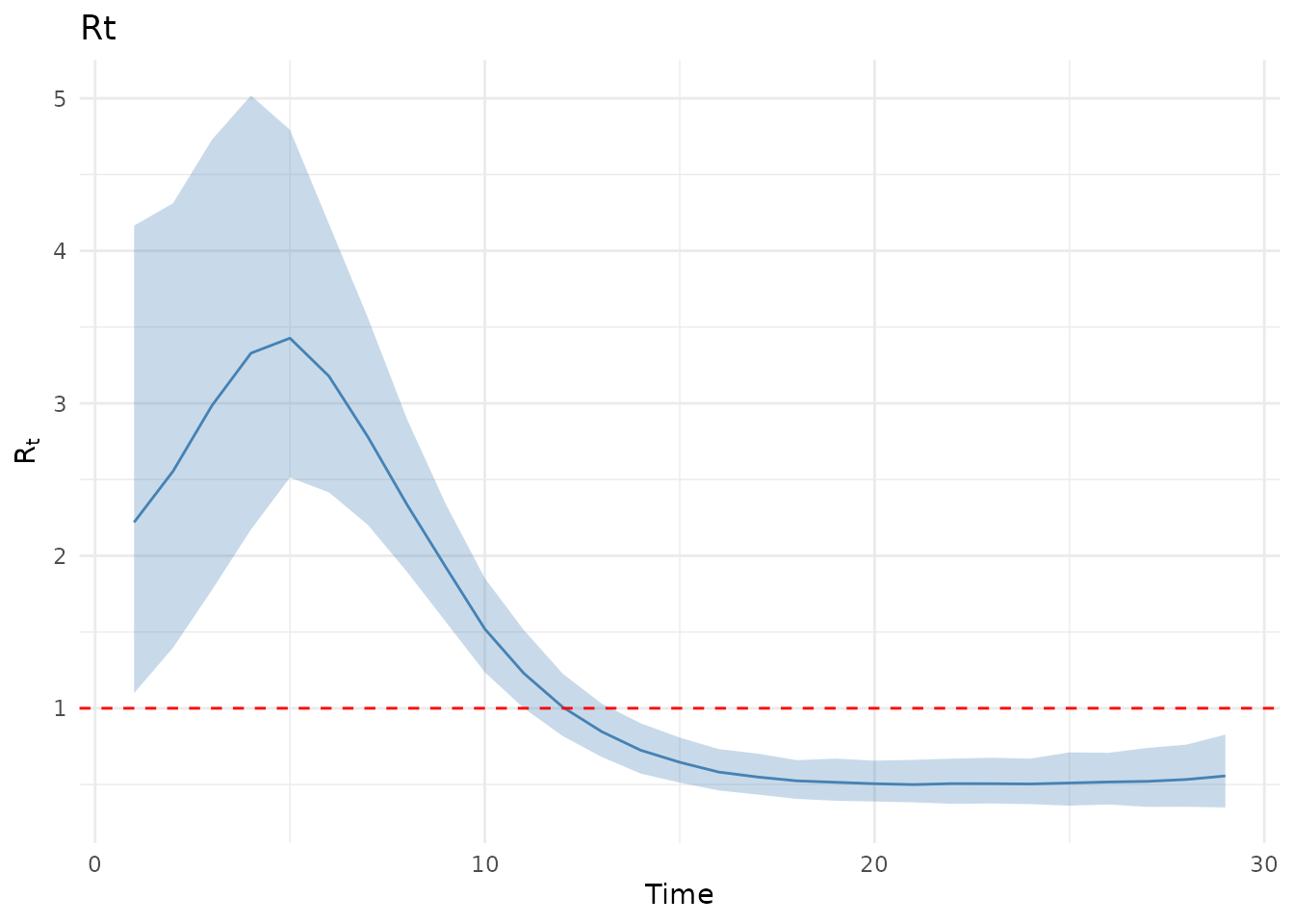
plot(results, type = "cases")
#> Could not simulate cases from model parameters.
#> Available parameters: latent.ar_init.1., latent.damp_AR.1., latent.std, latent.ϵ_t.1., latent.ϵ_t.2., latent.ϵ_t.3., latent.ϵ_t.4., latent.ϵ_t.5., latent.ϵ_t.6., latent.ϵ_t.7., latent.ϵ_t.8., latent.ϵ_t.9., latent.ϵ_t.10., latent.ϵ_t.11., latent.ϵ_t.12., ...
Swapping Components
The power of compositional modelling: easily test different assumptions!
Different Latent Processes
# Try a random walk instead of AR(1)
rw <- AR(
  order = 1,
  damp_priors = list(truncnorm(1.0, 0.01, 0.99, 1)), # Near 1 = random walk
  init_priors = list(norm(0, 0.5)),
  std_prior = halfnorm(0.1)
)

model_rw <- EpiProblem(
  epi_model = renewal,
  latent_model = rw, # Swapped!
  observation_model = negbin,
  tspan = c(1, 30)
)

results_rw <- fit(model_rw, data = outbreak_data)
Adding Delays
# Account for reporting delay
delayed_obs <- LatentDelay(
  model = negbin,
  delay_distribution = lognorm(log(2), 0.5) # ~2 day delay
)

model_delayed <- EpiProblem(
  epi_model = renewal,
  latent_model = ar1,
  observation_model = delayed_obs, # Swapped!
  tspan = c(1, 30)
)

results_delayed <- fit(model_delayed, data = outbreak_data)
Accessing Advanced Features
For Julia features not yet wrapped in R, use
epiaware_call():
# Create HierarchicalNormal error model
eps_model <- epiaware_call("HierarchicalNormal", halfnorm(0.1))

# Create MA(2) latent model
ma2 <- epiaware_call(
  "MA",
  theta_priors = list(norm(0, 0.1), norm(0, 0.1)),
  eps_t = eps_model,
  .param_map = c(theta_priors = "θ_priors", eps_t = "ϵ_t")
)

# Use in EpiProblem like any other component
model_ma <- EpiProblem(
  epi_model = renewal,
  latent_model = ma2,
  observation_model = negbin,
  tspan = c(1, 30)
)
The .param_map argument handles Greek letters in Julia
parameter names.
Understanding the Components
Distribution Constructors
EpiAwareR provides convenient functions for specifying priors:
# Normal distribution
norm(mean = 0, sd = 1)

# Truncated normal (bounded)
truncnorm(mean = 0.5, sd = 0.2, lower = 0, upper = 1)

# Half-normal (positive values)
halfnorm(sd = 0.1)

# Gamma distribution
gamma_dist(shape = 5, scale = 1)

# Log-normal distribution
lognorm(meanlog = 0, sdlog = 0.5)

# Exponential distribution
exponential(rate = 0.1)
Model Classes
Each component type has specific classes:
-
Latent:
AR(), orepiaware_call("MA", ...), etc. -
Infection:
Renewal(), orepiaware_call("SIR", ...), etc. -
Observation:
NegativeBinomialError(),LatentDelay(), etc.
Next Steps
Explore more advanced usage:
- Mishra Case Study: Replicate a published analysis
- EpiNow2 Comparison: Compare with EpiNow2 workflows
- Model Comparison: Use LOO for model selection
-
Custom Models: Access cutting-edge Julia features
via
epiaware_call()
Getting Help
-
Documentation:
?AR,?Renewal,?fit, etc. - Issues: GitHub Issues
- EpiAware Docs: Julia Documentation
Session Info
sessionInfo()
#> R version 4.6.1 (2026-06-24)
#> Platform: x86_64-pc-linux-gnu
#> Running under: Ubuntu 24.04.4 LTS
#>
#> Matrix products: default
#> BLAS:   /usr/lib/x86_64-linux-gnu/openblas-pthread/libblas.so.3
#> LAPACK: /usr/lib/x86_64-linux-gnu/openblas-pthread/libopenblasp-r0.3.26.so;  LAPACK version 3.12.0
#>
#> locale:
#>  [1] LC_CTYPE=C.UTF-8       LC_NUMERIC=C           LC_TIME=C.UTF-8
#>  [4] LC_COLLATE=C.UTF-8     LC_MONETARY=C.UTF-8    LC_MESSAGES=C.UTF-8
#>  [7] LC_PAPER=C.UTF-8       LC_NAME=C              LC_ADDRESS=C
#> [10] LC_TELEPHONE=C         LC_MEASUREMENT=C.UTF-8 LC_IDENTIFICATION=C
#>
#> time zone: UTC
#> tzcode source: system (glibc)
#>
#> attached base packages:
#> [1] stats     graphics  grDevices utils     datasets  methods   base
#>
#> other attached packages:
#> [1] EpiAwareR_0.2.0.9000
#>
#> loaded via a namespace (and not attached):
#>  [1] gtable_0.3.6         jsonlite_2.0.0       dplyr_1.2.1
#>  [4] compiler_4.6.1       tidyselect_1.2.1     jquerylib_0.1.4
#>  [7] scales_1.4.0         systemfonts_1.3.2    textshaping_1.0.5
#> [10] yaml_2.3.12          fastmap_1.2.0        ggplot2_4.0.3
#> [13] R6_2.6.1             labeling_0.4.3       generics_0.1.4
#> [16] distributional_0.8.1 juliaready_0.1.0     knitr_1.51
#> [19] backports_1.5.1      checkmate_2.3.4      tibble_3.3.1
#> [22] desc_1.4.3           RColorBrewer_1.1-3   bslib_0.12.0
#> [25] pillar_1.11.1        posterior_1.7.0      rlang_1.3.0
#> [28] utf8_1.2.6           cachem_1.1.0         xfun_0.60
#> [31] S7_0.2.2             fs_2.1.0             sass_0.4.10
#> [34] otel_0.2.0           cli_3.6.6            withr_3.0.3
#> [37] pkgdown_2.2.1        magrittr_2.0.5       grid_4.6.1
#> [40] digest_0.6.39        lifecycle_1.0.5      vctrs_0.7.3
#> [43] evaluate_1.0.5       glue_1.8.1           tensorA_0.36.2.1
#> [46] farver_2.1.2         ragg_1.5.2           abind_1.4-8
#> [49] JuliaConnectoR_1.1.5 rmarkdown_2.31       matrixStats_1.5.0
#> [52] tools_4.6.1          pkgconfig_2.0.3      htmltools_0.5.9